Winterization Failures That Shut Down Operations: Your Cold Weather Game Plan
During February 2021's Winter Storm Uri, natural gas production in Texas dropped nearly 45%. The Federal Energy Regulatory Commission (FERC) and the North American Electric Reliability Corporation (NERC) found that freezing conditions caused 44.2% of unplanned generating unit outages, with natural gas facilities accounting for 58% of all unplanned failures. The root cause in the majority of cases was the same: inadequate winterization of equipment that was known to be vulnerable to cold weather.
The U.S. Chemical Safety Board (CSB) has documented this pattern repeatedly. In the first three months of fiscal year 2023 alone, 36 incidents were reported under the CSB's accidental release reporting rule, including eight during a single Christmas weekend of record-low temperatures. Frozen piping that cracks under expansion does not always leak immediately. The damage becomes evident when temperatures rise and the ice thaws, releasing whatever the pipe was carrying.
Equipment That Fails First
Small-bore piping and dead legs. Sections of piping with no active flow lose heat fastest. Dead legs, including drain lines, sample points, and unused branches, freeze before main process lines do. The CSB recommends surveying all piping systems for dead legs and ensuring they are properly isolated, removed, or winterized before cold weather arrives.
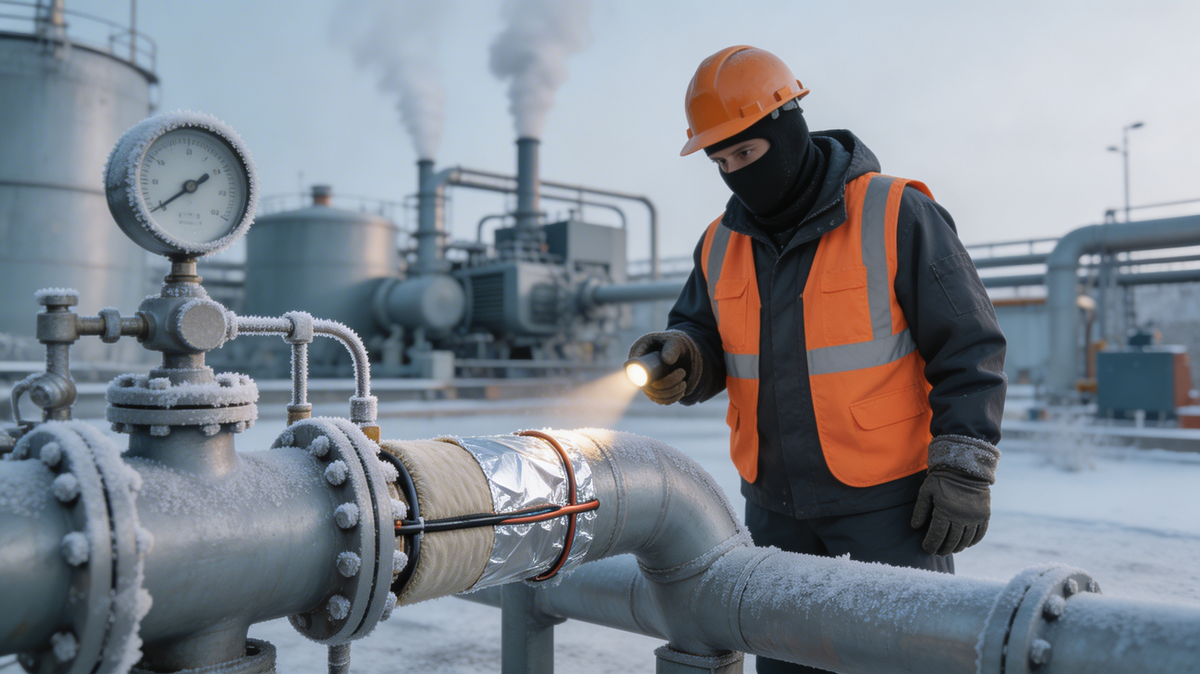
Instrument impulse lines. Pressure and level transmitters connected by narrow-gauge tubing are among the first instruments to freeze. When impulse lines solidify, operators lose visibility on process conditions, and control systems begin responding to stale or inaccurate data. Heat tracing on instrument lines is frequently overlooked during initial installation and rarely verified during pre-winter inspections.
Pressure relief devices. Relief valves and rupture disks exposed to moisture can freeze in the closed position, eliminating overpressure protection. Ice accumulation at discharge outlets can also block the relief path entirely.
The 30-Day Pre-Winter Protocol
Winterization programs should activate at least 30 days before the first anticipated freeze. The CSB recommends a formal, written freeze protection program that includes a facility-wide winterization checklist. Key steps include verifying heat trace circuit continuity and insulation resistance on every traced line, confirming thermostat setpoints (heat trace systems typically activate between 40°F and 50°F ambient), inspecting pipe insulation for damage, gaps, or moisture intrusion, draining and isolating all out-of-service piping, and testing backup power for critical heat trace circuits.
Heat trace systems use three cable types: self-regulating, constant wattage, and mineral insulated. Each has different inspection requirements. Self-regulating cable adjusts output based on temperature but still requires continuity checks and insulation resistance testing before each winter season.
When Systems Start Freezing
If freeze conditions develop despite winterization, the priority is maintaining process visibility and overpressure protection. Portable heat sources such as steam lances or electric heat blankets can be applied to frozen instrument lines, but open-flame heating near process piping creates ignition risk and should be prohibited. Frozen relief devices require immediate attention; if a relief valve cannot be confirmed functional, the protected equipment must be depressurized or shut down.
Documenting every freeze event and the response taken feeds into the next season's winterization plan through the facility's Management of Change (MOC) process.
Sources
- FERC/NERC Final Report on February 2021 Freeze: freezing issues caused 44.2% of unplanned outages; natural gas facilities represented 58% of all failures; Texas natural gas production declined nearly 45%. https://www.ferc.gov/news-events/news/final-report-february-2021-freeze-underscores-winterization-recommendations
- U.S. Chemical Safety Board — Winterization Safety Digest: 36 freeze-related incidents in Q1 FY2023; recommendations for dead-leg surveys, formal winterization checklists, and freeze protection programs. https://www.csb.gov/winterization/
- CSB Winterization Safety Digest (PDF): details on freeze-thaw damage mechanisms and process hazard analysis recommendations. https://www.csb.gov/assets/1/6/csb_winterization_safety_digest.pdf
- Inspired by: Winterization Safety Message (U.S. Chemical Safety Board). https://www.youtube.com/watch?v=mEtpUmYs1kg