The OSHA 6-Foot Rule(s): One rule with two VERY important meanings
Falls remain the leading cause of fatalities in construction, accounting for over 30% of deaths annually. OSHA’s 6-foot rule mandates fall protection for workers on unprotected sides or edges 6 feet (1.8 m) or more above a lower level. This trigger height applies to walking/working surfaces, leading-edge work, hoist areas, and similar exposures.
The 6 Foot "Height Threshold" Rule
Per OSHA regulations, when there is work on an unprotected side of edge at least 6 feet above a lower level Employers must provide a series of controls to contain the hazard. These include administrative controls such as warning areas and also engineering controls such as appropriatley installed guardrails, safety nets, scaffolds with toeguards and personal fall arrest systems (PFAS)—for all workers engaged in activity at the 6 foot threshold.
The 6 Foot "Maximum Free Fall Distance" Rule
The rule doesn’t stop at the trigger height. When PFAS is used, 29 CFR 1926.502(d)(16)(iii) requires the system be rigged so a worker cannot free-fall more than 6 feet or contact any lower level. Free fall is the distance BEFORE the system arrests the fall. Exceeding this limit dramatically increases arresting forces and injury risk. Systems must also limit maximum arresting force to 1,800 pounds with a body harness, cap deceleration distance at 3.5 feet, and withstand twice the potential impact energy of a 6-foot free fall.
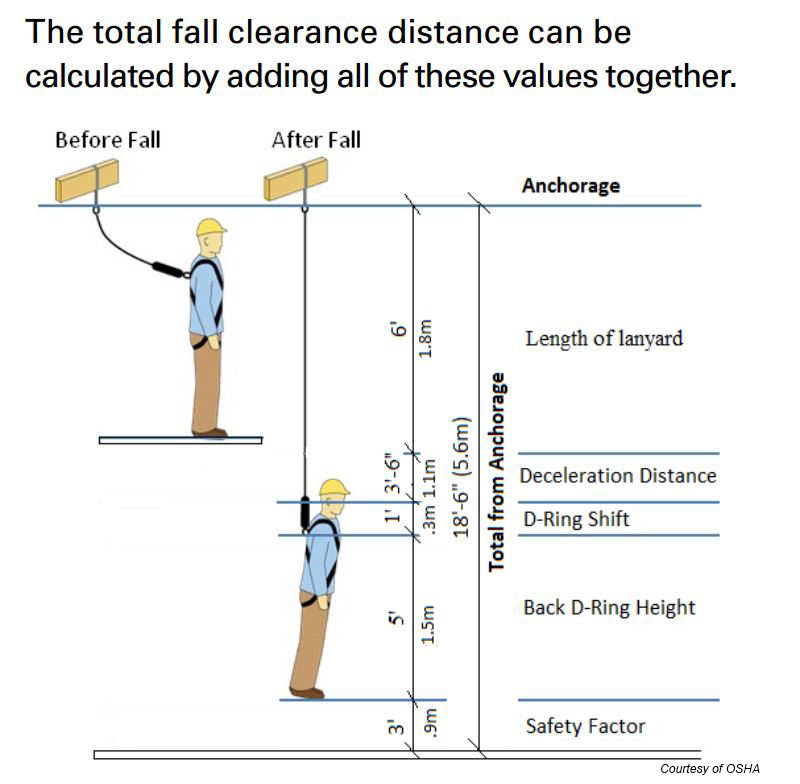
When wearing a harness and calculating an achor point the single most important consideration is your clearance calculation. This is simple math adding up the length of the various elements of your safety harness and comparing to the distance you could possibly fall (along with a 2 foot margin of safety just to be sure).
Clearance calculation is non-negotiable.
Total required clearance = free fall distance + deceleration distance + harness stretch/D-ring shift + worker height below the D-ring + safety margin
For a common shock-absorbing lanyard setup, a practical field estimate often looks like this:
- Free fall distance: up to 6 feet
- Deceleration distance: up to 3.5 feet
- Harness stretch and D-ring shift: about 1 foot
- Distance from dorsal D-ring to worker’s feet: about 5 feet
- Safety margin: about 2 feet
Insufficient clearance means striking beams, ground, or equipment—rendering the system useless. Workers and supervisors must measure every setup before work begins.
Choose an Anchor point that can support 5,000 pounds
Anchor placement drives effective clearance and safety. Per 1926.502(d)(15), anchorages must support 5,000 pounds per worker (or maintain a 2:1 safety factor under qualified-person design) and remain independent of platform supports. Ideal placement is directly overhead or above shoulder height to minimize free fall and eliminate swing falls, where a worker pendulums into obstacles. Side or below-D-ring anchors increase free-fall distance and swing radius, often demanding longer clearance or self-retracting lifelines (SRLs) that limit free fall to 2 feet. Anchors must be inspected, installed by qualified persons, and positioned to avoid sharp edges that could cut lifelines.
Proper rigging and placement prevent the “6-foot free-fall myth” from becoming reality. A worker who free-falls 6 feet generates forces far exceeding body weight;
Just as an example a worker that weights 250 pounds that free falls just 6 feet generates up to 1,500 fit-lbs of energy. We arrive at this number using the Potential Energy equation.
Potential Energy = W × h PE = 250 lbs × 6 ft PE = 1,500 ft-lbs of energy
Picking a poor anchor location compounds this into catastrophic swing impacts that can DECREASE the ability of your equipment to arrest your fall or result in a dangerous pendulum swing.
Ultimately, the OSHA 6-foot rule demands more than equipment—it requires worker knowledge. Don't just hand out PFAS harnesses, train your workers to calculate clearance, select anchors correctly, and inspect systems daily.