Confined Space Entry: The 3-Person Rule That Could Save Your Career
Every permit-required confined space entry under 29 Code of Federal Regulations (CFR) 1910.146 requires three distinct roles: an authorized entrant, an attendant, and an entry supervisor. The Occupational Safety and Health Administration (OSHA) mandates these roles for a reason. According to the National Institute for Occupational Safety and Health (NIOSH), over 60% of confined space fatalities involve would-be rescuers, and the Bureau of Labor Statistics (BLS) reports an average of 92 confined space deaths per year in the United States. Role confusion during an emergency is a leading contributor to those numbers.
The Three Roles and What They Actually Require
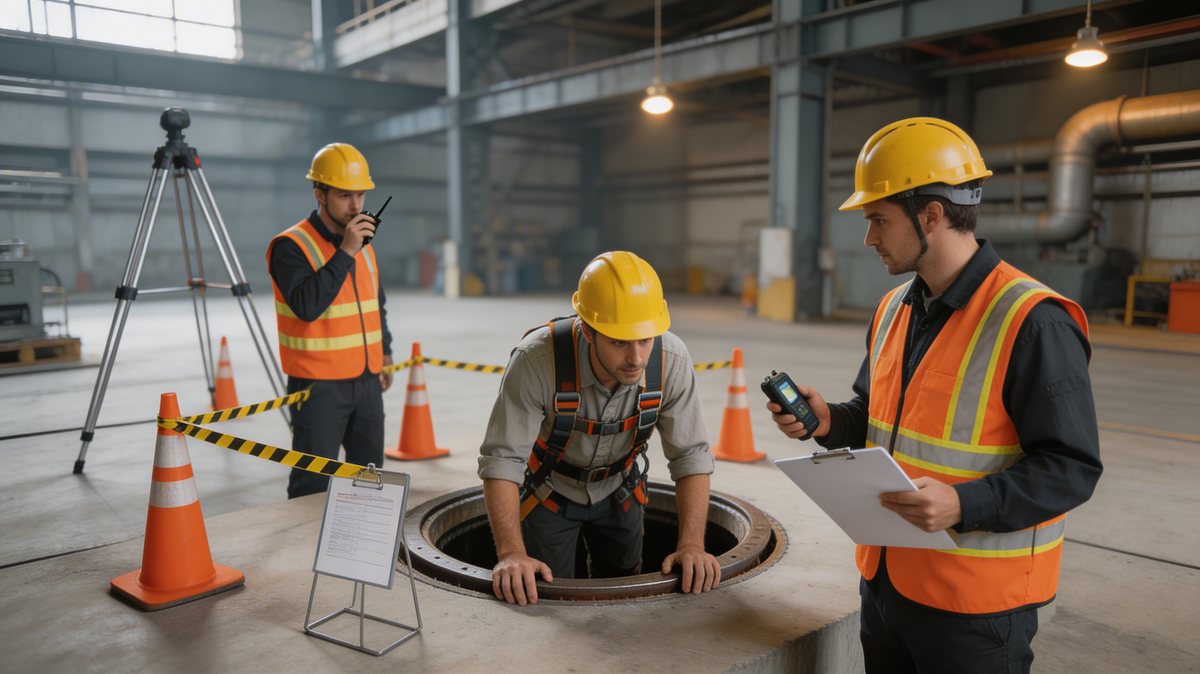
The Authorized Entrant is the person physically entering the space. Their responsibilities include understanding the hazards present, knowing how to use air monitoring equipment and breathing apparatus, maintaining communication with the attendant, and being prepared to self-rescue or evacuate on signal. Entrants must recognize the symptoms of exposure and know the exit procedure before they cross the threshold.
The Attendant remains stationed outside the permit space for the entire duration of the entry. They track the number of entrants, monitor conditions, and maintain continuous communication. The attendant does not enter the space under any circumstances unless properly relieved by another qualified attendant. This is where discipline matters. When an entrant goes down and instinct says go in after them, the attendant's job is to stay put, call for rescue, and keep the situation from getting worse.
The Entry Supervisor authorizes the entry after confirming that all pre-entry conditions are met: atmospheric testing is complete, ventilation is running, the permit is filled out and signed, and all personnel understand their roles. The supervisor can also terminate the entry at any point if conditions change. OSHA allows one person to fill multiple roles (for example, a supervisor who also serves as the attendant), but only if that person is trained and equipped for each role they take on.
Communication That Works in the Field
Verbal communication breaks down fast inside tanks, vessels, and underground vaults. Effective teams establish non-verbal signals before the entry begins. A common setup uses a tug-line system: one tug means "Are you okay?", two tugs back means "Yes," and three or more continuous tugs means "Evacuate now." Teams working in high-noise environments should also use hand signals with line-of-sight positioning and carry radios as a backup.
The communication plan goes on the entry permit. If the team cannot demonstrate the signals back during the pre-entry briefing, the entry does not proceed.
When to Abort
Any team member has the authority to stop a confined space entry. OSHA's standard is built on this principle: if the entrant feels lightheaded, if the attendant loses communication, or if the supervisor identifies a change in atmospheric readings, the entry stops. There is no override. Delayed evacuations account for a significant share of confined space injuries, and the decision to abort should never require a second opinion.
Training crews to challenge an unsafe entry takes repetition. Tabletop drills that simulate communication failures, unexpected atmospheric changes, and role-swap scenarios build the reflex to act rather than defer. The goal is to make stopping work feel as routine as starting it.
Sources
- OSHA 29 CFR 1910.146 — Permit-Required Confined Spaces: defines authorized entrant, attendant, and entry supervisor roles, duties, and training requirements. https://www.osha.gov/laws-regs/regulations/standardnumber/1910/1910.146
- NIOSH Publication No. 86-110 — Preventing Occupational Fatalities in Confined Spaces: reports that over 60% of confined space fatalities involve would-be rescuers. https://www.cdc.gov/niosh/docs/86-110/default.html
- Bureau of Labor Statistics Census of Fatal Occupational Injuries (CFOI): reports an average of 92 confined space fatalities per year in the United States. https://bhhcsafetycenter.com/by-the-numbers-confined-spaces/
- Inspired by: Confined Space Training — Preparing For Entry and Entering the Space (SafetyVideos.com). https://www.youtube.com/watch?v=yGyhKgheRm8